
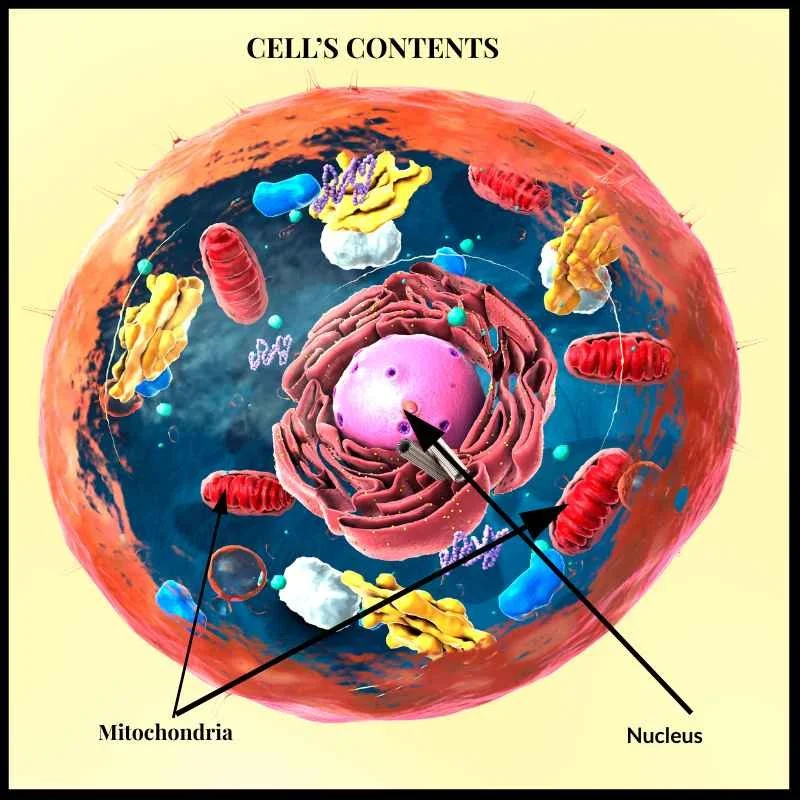
Until recently, the accepted theory for how cancers form was that mutations in DNA contained in the nucleus of cells can cause them to become immortal. These then divide and grow into tumours and other cancers.
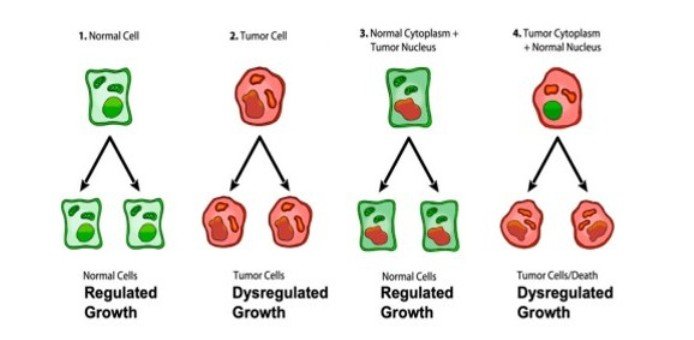
The problem with this theory is that not every cancer has mutations. And one researcher has proved that the problem isn’t in the cell’s DNA but in the cytoplasm that surrounds the nucleus (1). You can see this in the image below. He swapped the nucleus from a cancer cell with that of a healthy cell, which didn’t turn cancerous. But when he transplanted the nucleus from a healthy cell into the cytoplasm of a tumour cell, the cell stayed cancerous.
Seyfried TN, Chinopoulos C. Can the mitochondrial metabolic theory explain better the origin and management of cancer
than can the somatic mutation theory? Metabolites. 2021;11(9):572. doi:10.3390/metabo11090572
An alternative theory is now circulating. Under this theory, which is gaining traction, chronic damage to the mitochondria causes the changes to cells that result in cancer. Mitochondria live in the cytoplasm of a cell (1).
Mitochondria are best known for being the producers of ATP, which is the energy source for each cell. But they do a lot more than that. They are responsible for communication between cells, for directing the energy that is produced, orchestrating immune function, and deciding the fate of the cell.
When things go wrong in the mitochondria’s energy production, it produces a lot of free radicals or reactive oxygen species (ROS) and acidifies the area around the damaged cells. This can cause the genetic mutations that often, but not always, occur in cancer cells.
Cancer cells need a huge amount of energy and building blocks for proteins and lipids (fats) to fuel the growth of new cells and allow them to reproduce.
We know the first part of energy production as glycolysis. It’s pretty inefficient, but it takes glucose from digestion of our food and normally produces 2 molecules of ATP, which is the way we store energy. In healthy cells, the side products enter a different phase of energy production, known as oxidative phosphorylation, which produces up to another 36 molecules of ATP and carbon dioxide.
It’s the oxidative phosphorylation step that goes wrong in the mitochondria, and cancer cells sometimes take advantage of glycolysis instead in several ways:
It can produce the building blocks for new cells (2).
It protects the cancer cells from the ROS that are generated by the rapid division of cells (3).
It starves the immune system of fuel and reduces its effectiveness (4).
Glycolysis is often called the Warburg effect because a researcher called Warburg discovered it in cancer cells in 1924. But he didn’t know what we know now about its advantages for cancer cells.
Because cancer cells need huge amounts of energy, which many of them get from glucose, if you starve them of glucose as much as possible, you can help stop them growing and deprive them of the advantages that glycolysis gives them.
With little glucose in the diet, keto also reduces insulin levels and insulin-like growth factor in the body. Researchers have shown that both these promote cancer growth (5).
Another factor in cancer growth is carrying extra weight. Fat cells increase inflammation in the body, which can cause damage to the mitochondria. A calorie-restricted keto diet can help with weight loss, and because it reduces hunger hormones, it’s a fairly painless way to lose weight. Fatty foods slow down stomach emptying, so you feel full longer too.
In the next instalment, we talk about the latest research into using keto diets for cancer. Before you dive straight into changing your diet, you need to know that not every type of cancer responds to a keto diet, and in some cancer types, it can speed up tumour growth. So stay tuned for the next part of this series.
If you have enjoyed this article, you can sign up for my Treatment Support newsletter to get an article sent to you each month. As a thank you gift, I’ll send you a free booklet on Soothing Side Effects. Learn more here.
If you’re more interested in articles about cancer prevention, I have another newsletter that goes out each month covering that. The thank you gift for that is a collection of recipes aimed at cancer patients (not keto). Click this link to find out more.
Diet is not the only way to support yourself during cancer treatment. There are also lifestyle changes that can help a great deal, as well as supplements and herbs. You can find out all about those in my book, Naturally Supporting Cancer Treatment. Learn more by clicking here.
References
Seyfried TN, Chinopoulos C. Can the mitochondrial metabolic theory explain better the origin and management of cancer than can the somatic mutation theory? Metabolites. 2021;11(9):572. doi:10.3390/metabo11090572
Liberti MV, Locasale JW. The Warburg effect: How does it benefit cancer cells? Trends in Biochemical Sciences. 2016;41(3):211-218. doi:10.1016/j.tibs.2015.12.001
Mukherjee P. Revisiting the warburg effect: Modern understanding, existing misconceptions and evolving concepts in cancer metabolism. Published online January 16, 2026. doi:10.20944/preprints202601.1236.v1
Chen J, Cao X, Li B, et al. Warburg effect is a cancer immune evasion mechanism against macrophage immunosurveillance. Frontiers in Immunology. 2021;11:621757. doi:10.3389/fimmu.2020.621757
Khodabakhshi A, Akbari ME, Mirzaei HR, Seyfried TN, Kalamian M, Davoodi SH. Effects of ketogenic metabolic therapy on patients with breast cancer: A randomized controlled clinical trial. Clinical Nutrition. 2021;40(3):751-758. doi:10.1016/j.clnu.2020.06.028