
Vagus Nerve Stimulation: Benefits for Health and Healing
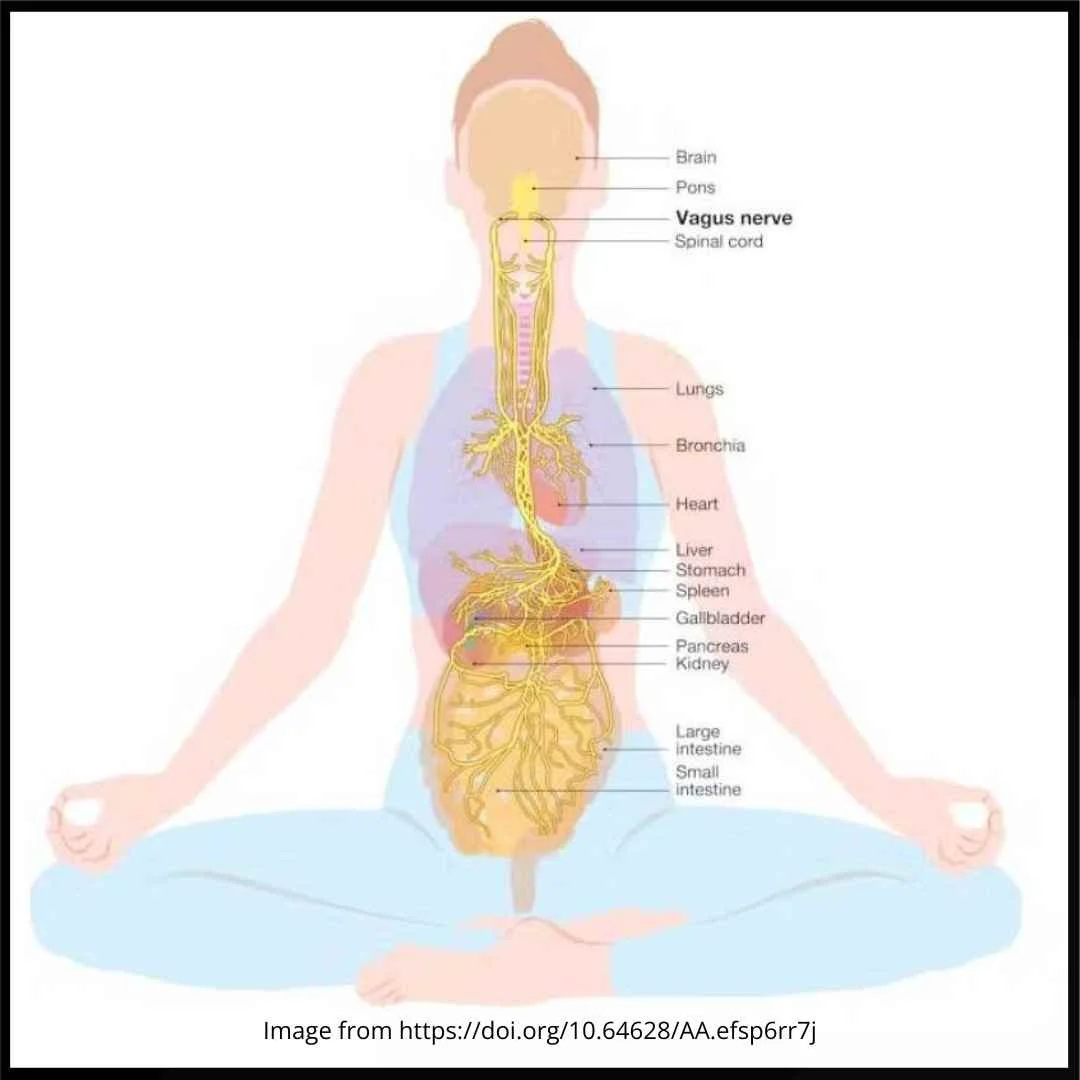
Let me introduce you to the vagus nerve, the longest nerve in the human body. Vagus is Latin for wandering, and that's exactly what it does in the body. It starts in the brain and goes right down the length of the body, sending offshoots to the:
Eyes
Facial muscles
Throat
Larynx (voice box)
Oesophagus (food pipe)
Heart
Lungs
Pancreas
Stomach
Liver
Gall bladder
Small and large intestines
You could describe it as the software that runs the organs in the body. It signals to and from the brain, letting the brain know what's going on in the body and then controlling how the organs respond. It runs the parasympathetic nervous system, also known as the rest and digest response, as opposed to the sympathetic nervous system, which we call the fight or flight response.
When you're stressed, the sympathetic nervous system is in control. Your pupils dilate to help you see better; your throat and oesophagus might constrict because you won't need to swallow food; the heart rate speeds up and so does your breathing; inflammation rises to help you cope with potential injury; and your digestive system shuts down. These are all useful for short periods if you're escaping a predator or are experiencing danger. If your vagus nerve is doing its job properly, your body should return to the rest and digest state fairly quickly.
With all the stress in today's world, we can sometimes experience long periods of stress, which send the vagus nerve out of balance, known as poor vagal tone.
The results of poor vagal tone can be significant:
You might experience trouble swallowing.
Your heart runs on overdrive, so your pulse runs faster, and your blood pressure can rise.
You breathe quickly and shallowly all the time, so you don't get enough oxygen in your blood.
Digestion suffers, so you might experience heartburn, constipation, diarrhoea, irritable bowel syndrome (IBS), or inflammatory bowel disease.
You have a weaker immune system.
Inflammation is high, which can cause a multitude of illnesses, including autoimmune conditions, heart problems and cancer.
You can tell whether your vagal tone is good by your heart rate variability (HRV). If you have an ECG, you can see that the distance between the up strokes varies, which clearly shows your HRV. Your pulse rate is also an indicator; it rises and falls constantly. If you have a smart watch, you may get an HRV reading from it. You will certainly have a pulse reading, and the higher the difference in your pulse rate, the better your HRV. A higher HRV means good vagal tone.
How vagus nerve stimulation benefits cancer patients
Cancer patients with a higher HRV have a better survival rate than those with lower HRV, according to a systematic analysis and meta-analysis of 11 studies on groups with various types of cancer (1).
An animal trial used a drug that successfully prevents breast cancer metastasis by stimulating the vagus nerve. Half of them had their vagus nerves removed, and those had higher rates of metastasis (2).
A similar animal trial on colon cancer that had metastasised to the liver showed that the animals without a vagus nerve had a poorer outcome (3).
Given that improving your HRV is easy to do, it is worthwhile incorporating this into your treatment.
How to stimulate your vagus nerve
You can improve your vagal tone by stimulating the vagus nerve. There are a wide variety of ways to do this. You should find some methods here that suit you.
Breathing exercises to boost vagal tone
You may think that this means 'take a deep breath'. Actually, it doesn't. When you breathe in, your heart rate increases. But when you breathe out, it drops. So, the aim of the game is to make exhaling last longer than inhaling, twice as long if you can.
This is what mindfulness meditation is about — slowing down your breath. Just count your breaths and you're meditating, focusing on that and nothing else. That is why it is such a powerful boost to your health. It increases your HRV and boosts vagal tone.
Humming, singing and gargling stimulate your vagus nerve
Humming, singing and gargling are really forms of breathing exercises. In each case, your breath out will be longer than your breath in.
We hum and sing when we are happy, but stimulating your vagus nerve reduces stress, so this could be a two-way street. You can improve your mood by humming and singing. Find some uplifting songs and join in. Perhaps consider joining a choir.
Maybe Eastern monks knew something when they hummed 'Om' during meditation.
Laughing is good for your vagus nerve
Laughing slows down your breathing too. If you've ever had a good belly laugh, you know it makes you feel good. That is because it has a positive effect on your vagus nerve. The nerve connects to the facial muscles and sends messages back to the brain.
If you don't feel you have anything to laugh about, fake it till you make it. That is why people created laughter clubs. Joining other people and just laughing is very infectious. There are laughter clubs worldwide, but if there isn't one near you, look for an online club. They're just as effective.
Vigorous exercise is excellent for your vagus nerve
A great way to boost your vagus nerve is through vigorous exercise. Exercise stimulates the vagus nerve to produce Vasoactive Intestinal Peptide (VIP), a protein which helps the heart to contract more vigorously and increases blood supply to it (4).
Eye exercises to boost vagal tone
A simple 2-minute exercise that is perfect for bedtime is one that Stanley Rosenberg described in his book The Healing Power of the Vagus Nerve:
Lying on the bed, interlace your hands behind your head. Turn your head slowly to the right. Notice if it causes pain or discomfort, and rate that out of 10. Repeat on the left-hand side.
Returning your head to the middle and holding it there, look to the right as far as you can. After a minute or two, you may get the urge to yawn, sigh or swallow. When that happens, bring your eyes back to the centre.
Look to the left as far as you can. Again, when you get the urge to yawn, sigh or swallow, bring your eyes back to the centre.
Turn your head slowly to the right and then back to the left, rating the stiffness in your neck again.
This exercise realigns the vertebrae in your neck, increases range of motion and boosts blood flow to the brain, as well as relaxing you before you go to sleep.
Stimulate the vagus nerve with cold water
A short cold shower or dip in a pool will shock your vagus nerve and increase vagal tone.
Splashing your face with cold water has a similar effect. An ice pack on the back of your neck also works.
Massaging your ears improves vagal tone
Massaging your ears is an effective way to relax you and stimulate your vagus nerve. The nerve is close to the surface in your ears.
One point is just above the ridge above your ear canal. Using your index finger, make small circles here.
You can also put your finger at the entrance to the ear canal and gently press towards the back of your head as you make small circles.
There are electrical tools available that you can use to stimulate these points, but you can do it just as well yourself.
Tapping (EFT) increases vagal tone
Tapping, also known as Emotional Freedom Technique (EFT), involves tapping your fingers on specific acupressure points in your body whilst focusing on whatever is causing you distress. This is a technique that I use every day, and it is very effective.
For details on how to do it, you can check out this article.
Alternatively, there is an excellent app available called The Tapping Solution. That is what I use, and they have 3 guided vagus nerve Tapping sessions (5). I highly recommend it (I have no financial relationship with them). There is a free version with a few guided sessions.
Support your vagus nerve using diet
The vagus nerve has branches throughout our digestive system. Scientists regard the gut as the second brain because of its similar neural network. The bacteria in our gut produce chemicals that stimulate the vagus nerve, which sends messages directly to the brain. That is the origin of gut feelings. We need to make sure that our gut bacteria are the right species and that we keep them happy.
The best way to do this is by eating a diet full of vegetables, fruit, nuts, seeds, and wholegrains. That supplies the fibre that bacteria in the large intestine feed on. The breakdown of fibre by these bacteria produces short-chain fatty acids, such as butyrate, acetate and propionate, which have an anti-inflammatory effect on the body.
You can also add probiotic foods like live yoghurt, kefir, kombucha, miso, kimchi, sauerkraut and tempeh to encourage the right species of bacteria. Alternatively, a good probiotic with Lactobacillus and Bifidobacterium species works. You can find dairy-free versions.
Omega-3 fatty acids provide the fat needed to create myelin, which is the protective, insulating layer around each nerve, including the vagus nerve. Oily fish help, but you need a good quality fish oil to provide the amounts you need.
Conclusion
Vagal nerve stimulation has powerful effects on our health. It controls the way our major organs work, improves our wellbeing and our mood. For cancer patients, it can improve their very survival. It costs nothing to improve your vagal tone and is simple to do. Try one or more of the methods above, and see the difference you feel.
You can find many other ways to improve your health and mood in my book, along with many ways to support cancer patients during and after treatment. You can find all the online stores that stock the book by clicking on the button below.
References
Huang W-B, Lai H, Long J, et al. Vagal nerve activity and cancer prognosis: A systematic review and meta-analysis. BMC Cancer. 2025;25(579). doi:10.1186/s12885-025-13956-w
Erin N, Duymuş Ö, Öztürk S, Demir N. Activation of vagus nerve by SEMAPIMOD alters substance P levels and decreases breast cancer metastasis. Regulatory Peptides. 2012;179(1-3):101-108. doi:10.1016/j.regpep.2012.08.001
Hiramoto T, Yoshihara K, Asano Y, Sudo N. Protective role of the hepatic vagus nerve against liver metastasis in mice. Neuroimmunomodulation. 2018;24(6):341-347. doi:10.1159/000487483
Schrader J. Surprising ways the vagus nerve activates during exercise. Psychology Today. September 30, 2023. Accessed September 23, 2025. https://www.psychologytoday.com/au/blog/the-athletes-way/202309/surprising-ways-the-vagus-nerve-activates-during-exercise.
Ortner N. Vagus nerve tapping: A complete guide to natural nervous system regulation. The Tapping Solution. November 7, 2024. Accessed September 23, 2025. https://www.thetappingsolution.com/blog/vagus-nerve-tapping/.